
Data Centres & Industry
Energy infrastructure designed around how you operate
Data centres and large industrial consumers need supply that is resilient, controllable and affordable over decades. Storage, on-site or nearby generation and a capable control layer make that possible when they are designed together.
Approach
From demand analysis to operation
Demand analysis
Load profile, criticality, growth plans, grid capacity and tariff exposure.
Supply and storage strategy
PV plus storage options, firming and resilience requirements, local market rules.
System architecture
Equipment, connection and protection design matched to the operational need.
Energy management and control
EMS, monitoring and intelligent control so the system does what the business needs.
Investment case
Design choices tested against cost, revenue and risk before procurement.
Delivery and operation
Coordinated execution, commissioning and lifecycle follow-up.
Data centres
Firm renewable supply and storage strategies
Storage turns variable renewable generation into supply that can be matched to consumption hour by hour, and adds resilience at the connection point. We help operators, developers and investors size and structure it.
- Site and grid-capacity qualification
- PV plus storage firming strategies
- Coordination with operators, investors and EPCs
Industry
Industrial microgrids and large consumers
Spain's self-consumption rules allow generation near the consumer to supply industrial sites through the grid within a defined distance. Combined with storage, this supports shared schemes for industrial estates and multi-site consumers.
- Shared self-consumption schemes
- Storage to move solar output into evening peaks
- Design, procurement and operating model as one package
Cooling
Liquid cooling: direct-to-chip and immersion
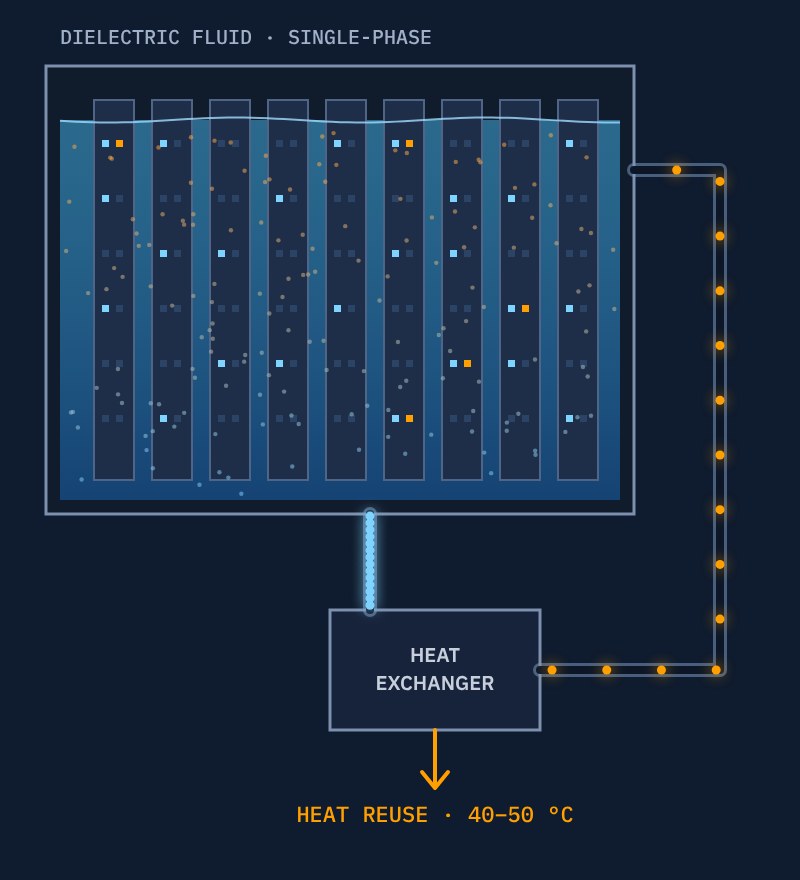
AI racks already exceed 100 kW, while air reaches about 20 kW per rack. Liquid cooling removes heat at the chip itself or by immersing servers in a dielectric fluid: it uses less energy, almost no water, and delivers heat at 40–50 °C that can be reused.
How we integrate it
- Cooling sets the power: at PUE 1.1 instead of 1.5, a 10 MW IT data centre needs about 4 MW less grid capacity.
- Compliance: Spain's decree asks for the top EU water-efficiency class and a transitional PUE of 1.25. Evaporative air cooling struggles to get there.
- Heat at 40–50 °C can feed industrial processes or heat networks on the estate.
- We design cooling, PV, batteries and EMS as one system, and audit the manufacturers of tanks, fluids and CDUs.
- For immersion we check server warranties, maintenance and fluid type. We prefer single-phase: the fluorinated fluids of two-phase systems fall under the EU PFAS restriction.
| Technology | Density per rack | Typical PUE | Water | Where it fits |
|---|---|---|---|---|
| Air (containment or rear door) | Up to ~20 kW; ~100 kW with rear-door heat exchangers | ≈ 1.5 | High if evaporative | Existing halls and conventional IT loads |
| Direct-to-chip (cold plate) | 100–175 kW | 1.10–1.20 | Closed loop, low | Today's standard for AI racks |
| Single-phase immersion | Up to ~250 kW | 1.03–1.10 | Near zero | Highest density, water-stressed sites, heat reuse |
Typical ranges published by the industry in 2026. Every project is sized on its real load.
Start a conversation
Planning energy infrastructure for a site?
Share your load, location and timing. We will tell you which options are worth studying and what it takes to deliver them.